
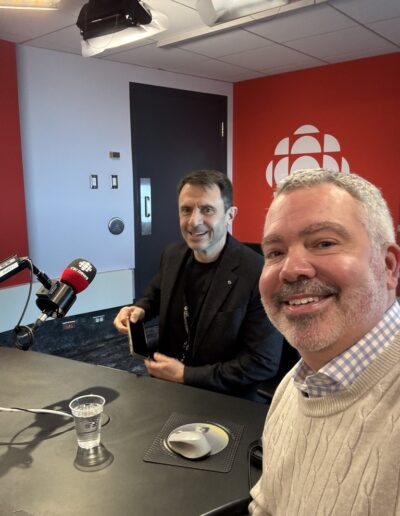
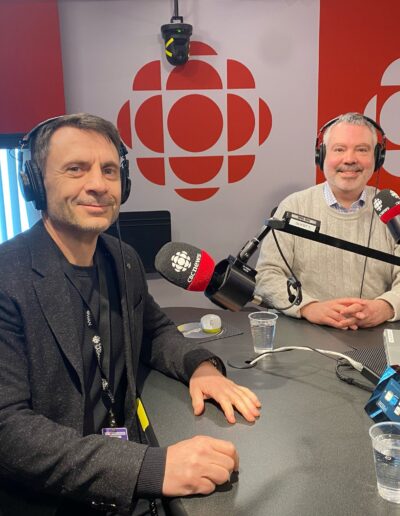
In March I visited Regina to share how Japan—the world’s oldest society—uses technology, design and culture to help older adults live not just longer, but better. While there, I joined CBC Radio One’s Blue Sky with host Theresa Kliem and Dr. Thomas Hadjistavropoulos, Director of the Centre on Aging and Health at the University of Regina, for a conversation about what Canada can learn from Japan—and the practical innovations already underway in Saskatchewan.
Why look to Japan?
Japan faces the realities of advanced aging sooner than most countries (about 30% of the population is 65+). The response isn’t only technological—it’s cultural. Ideas like ikigai (everyday purpose) and pin pin korori (“live long, die short”) encourage people to stay engaged and active right up to the end. That mindset, combined with family involvement and personal responsibility for health, means later entry into institutional care and wider use of everyday tech among older adults.
What we discussed on CBC’s Blue Sky
- Purpose drives adoption. People with strong purpose adopt tech that clearly enables what matters—connection, learning, hobbies, and mobility. The best “age tech” helps us be more human, not merely monitored.
- Connection beats isolation. Smartphones (and, in Japan, the Line app) are common even in people’s 80s and 90s, but real adoption requires patient human support—family, neighbours and intergenerational programs.
- Design for dignity and delight. “Age tech” isn’t just fall detection and vitals. It’s also companionship and enrichment (from simplified tablets to kawaii companion robots) that fight loneliness and keep people engaged.
- Prevention and practical safety. Saskatchewan is moving the needle with fall detection, computer-vision gait analysis, and new work on computer vision for pain detection in residents with severe dementia—bringing scarce caregivers to the right person at the right time.
- Lifestyle still matters most. Heart-healthy diet, safe exercise, quality sleep and continuous brain engagement remain the strongest general protections against cognitive decline. Technology should make these easier.
What Saskatchewan is already doing
We heard local examples that extend safe independence today:
- Unlocked, inclusive care environments supported by discreet door alerts and optional GPS wearables so residents can safely access larger community spaces.
- Communication tech for dignity—FaceTime and text-to-speech that “gives voice” back to residents.
- Intergenerational mentorship—Grade 6 students helping elders learn and troubleshoot technology.
- Community-powered purpose—active groups like the Saskatoon Seniors Fitness Association.
- Takeaways for innovators & policymakers
- Build with users, not for them. Start from lived needs; co-design with older adults and caregivers.
- Make connection effortless. Budget for onboarding and ongoing support—not just devices.
- Measure what matters. Track safety metrics and “meaning metrics” (social contact, learning, volunteering).
- Design for joy. If it doesn’t delight, it won’t stick. Human warmth and cultural cues drive adoption.
- Think ecosystem. Align health, housing, transit and community orgs so solutions compound rather than fragment.
Thank you to CBC’s Blue Sky and Theresa Kliem for the thoughtful conversation, and to Dr. Thomas Hadjistavropoulos and the University of Regina for hosting my lecture, Live Long, Die Short: Aging at the Intersection of Technology, Philosophy, and Purpose.
Blue Sky on CBC Radio One — Full Transcript (Lightly Edited for Clarity)
You can listen to the episode at Blue Sky on CBC Radio One
Program: Blue Sky (CBC Radio One)
Location: Regina, Saskatchewan
Host: Theresa Kliem
Guests:
- Dominic Carter
- Dr. Thomas Hadjistavropoulos
Additional voices: Callers and a guest from Sherbrooke/Central Haven
Notes: Light edits for punctuation, obvious word errors, and truncated phrases. Timing kept. Broadcast breaks and repeated station IDs minimally condensed. Names, organizations, and email domain corrected where context was clear. The conversational, on‑air feel is preserved.
—
**00:00:04 Announcement**
Blue Sky on CBC Radio 1. We’re coming to you from the traditional territories of the **Dene**, **Cree**, **Saulteaux**, **Dakota**, **Lakota**, and the homeland of the **Métis**.
**00:00:18 Theresa Kliem (Host)**
We are all getting older, and as our population ages, many people are trying to figure out how best to use technology to support aging adults to live longer, fuller lives. Japan has long been looked to as a leader in technology, but it also has a rapidly aging population. So today on *Blue Sky*, we’re going to talk about the lessons Canada can learn from Japan when it comes to aging. We’ll also hear about some of the technologies already being used in our province to better support aging adults.
**00:00:48 Theresa Kliem (Host)**
And of course, we want to hear from you. What does aging well look like for you? Have you embraced any technologies that have allowed you or a loved one to stay in your home longer? Call us at **1‑800‑716‑2221** or email **bluesky@cbc.ca**. Tonight, the University of Regina **Centre on Aging and Health** is hosting a public lecture. The topic is *Live Long, Die Short*.
**00:01:21 Theresa Kliem (Host)**
*Subtitle: Aging at the Intersection of Technology, Philosophy, and Purpose.* The person giving that lecture is in our Regina studio right now. **Dominic Carter** has just flown in from Japan. He’s a long‑time resident there and a consumer researcher whose business connects people who want to invest in technologies that help people live and age better. Tonight, he’ll be talking about the lessons our country can learn from Japan. But first, he’s graciously agreed to be our guest this noon hour.
**00:01:51 Theresa Kliem (Host)**
Dominic, welcome to Saskatchewan and welcome to *Blue Sky*.
**00:01:55 Dominic Carter**
Thank you for having me.
**00:01:56 Theresa Kliem (Host)**
And also joining him in the studio is **Dr. Thomas Hadjistavropoulos**. He is the Director of the Centre on Aging and Health at the University of Regina. Thomas, thanks for being with us, and welcome to *Blue Sky*.
**00:02:09 Dr. Thomas Hadjistavropoulos**
Thank you very much for having me.
**00:02:11 Theresa Kliem (Host)**
Dominic, I’m starting with you. Paint us a picture of what’s going on in Japan right now regarding people and aging.
**00:02:22 Dominic Carter**
Sure. One thing a lot of people may not realize is that Japan has the oldest population that has ever existed in the history of the world. At this point, about **30%** of the population is over the age of 65. So, in Japan we’re dealing with completely unprecedented issues: how do we successfully manage a population like that? We’re learning as we go.
**00:02:52 Dominic Carter**
So far, I think we’re doing a pretty good job—but Japan is a little further ahead than most of the rest of the world. The issues Japan is dealing with now are the issues countries in Europe and North America will deal with in due course.
**00:03:09 Theresa Kliem (Host)**
And how does what Dominic just described compare with what’s happening here in Canada—particularly in Saskatchewan?
**00:03:23 Dr. Thomas Hadjistavropoulos**
In Canada, the proportion of older adults in the general population is not quite as high as in Japan—about **20%** here. Still, people 65+ are the fastest‑growing demographic. We project that in about 40–45 years, **one in four** Canadians will be over 65. So the numbers are rapidly increasing, but we’re not yet at Japan’s level.
**00:04:06 Theresa Kliem (Host)**
Let’s talk about whether we’re prepared for this. Having lived in Europe and now North America—and looking at Japan—I understand different cultures approach aging very differently. Dominic, how is aging thought about in Japan?
**00:04:26 Dominic Carter**
In Western culture, we tend to worship youth. As the years go by, it’s quite normal to do extreme things to “turn back the clock.” Japan isn’t really like that. On the whole, people accept aging as a natural process.
**00:04:56 Dominic Carter**
Certainly, people don’t want to look older than their age. If I’m in my mid‑60s, I don’t want to look older than someone else in their mid‑60s—but I don’t need to look 40 when I’m 65. There’s generally an acceptance of aging as a natural process and less of a perception that aging is a “problem to fix.” In the West, we’re very focused on fixing things.
**00:05:32 Theresa Kliem (Host)**
Do you think that acceptance helps Japan approach an aging population—perhaps “manage” it better?
**00:05:43 Dominic Carter**
I think it does—it helps manage expectations. People expect the changes that come with aging and work hard to stay healthy. In fact, the average age at which people go into care in Japan is significantly later than in many countries, partly because people take care of their health. There’s also a sense of shame in asking for help—not necessarily a good thing—but people do cooperate to make it as easy as possible for society to manage.
**00:06:29 Theresa Kliem (Host)**
I want to include our listeners. What does aging well look like for you in Saskatchewan? Have you embraced technologies that have allowed you or a loved one to stay in your home longer? Call us at 1‑800‑716‑2221 or email **bluesky@cbc.ca**. Dominic, on what you just said—
**00:07:00 Theresa Kliem (Host)**
—I’m interested in why people go to hospital or into care later. You mentioned people seem to take more care of their health. Why is that?
**00:07:11 Dominic Carter**
They’re healthier on average. And families take a greater role than in many Western countries in caring for their elders. In Japan, you’ll often have caregivers in their late 70s caring for people in their 80s. You might see a wife caring for her husband, for example. So we have people we’d consider “elderly” doing quite heavy physical work—helping with lifting, bathing, getting dressed, and so on—when in our societies we might think they’re due for care themselves.
**00:08:01 Theresa Kliem (Host)**
Thomas, what are you seeing? We’ve talked about the “sandwich generation”—people raising kids while caring for parents. Are we really that different?
**00:08:21 Dr. Thomas Hadjistavropoulos**
In some ways, yes. Most caregivers in Canada—and in Saskatchewan—are not as old as Dominic described; most are adult children of the care recipients. We also see a lot of women in nursing homes compared to men, in part because women live longer. And attitudes differ: during the pandemic, we saw social media posts implying older adults were expendable. I doubt we’d see that in Japan. I hope attitudes are changing here, but Japan likely values older adults—their contributions and wisdom—more than we do.
**00:09:57 Theresa Kliem (Host)**
Dominic, this brings us to the philosophy behind aging. Your presentation tonight is about **ikigai**—personal purpose—and **pin pin korori**—“live long, die short.” How does this fit with what Thomas just said about different views on aging?
**00:10:21 Dominic Carter**
We can look at Japan’s ideal of aging through *pin pin korori*. A good example is the late **Queen Elizabeth II**: she lived to a ripe age, met the new prime minister, then took what might have been her first “sick day” in decades, and shortly after, passed away. She was fully engaged in life and service until the end. In Tokyo, you’ll see people in their 80s working in ramen or Chinese restaurants—still very much “in it.” *Pin pin korori* is: I’ll keep going, and one day I’ll die—and it will happen quickly.
**00:11:24 Dominic Carter**
**Ikigai**, on the other hand, is what makes you want to live like that. It’s whatever gets you up in the morning. It doesn’t have to be grand. In the West, we often think we need big life goals, or our lives have no meaning. In Japan, it can be modest: tending a bonsai, caring for a pet, practicing calligraphy. It’s small, habitual engagement—a modest form of happiness that’s still central to how many Japanese think about living.
**00:12:38 Theresa Kliem (Host)**
I’d love to hear our listeners’ **ikigai**—your personal purpose. What gets you up in the morning and keeps you going? Our number is 1‑800‑716‑2221, and our email is **bluesky@cbc.ca**. Anecdotally, my father (who had dementia) passed away; my mother has Parkinson’s and dementia. It seemed both declined when their purpose disappeared. My dad retired and did less socially; my mom collapsed after his death. I can relate to purpose being helpful. Dominic, your research talks about this—why is purpose so important?
**00:13:36 Dominic Carter**
When we think about technology, adoption can be challenging among older adults. What we’ve found is that people with strong purpose—**high ikigai**—are more inclined to age **with** technology. If we envision a future powered by technology, it also has to help us live happier lives and support our **ikigai**.
**00:14:17 Theresa Kliem (Host)**
How can technology do that—help adults have a sense of fulfillment?
**00:14:23 Dominic Carter**
That’s the question. When people hear “age tech,” they think mostly of care—care homes, assisted living. That’s important; caregivers have tough jobs and there are many misses technology can help prevent. But why should “age tech” exclude tools that help us avoid loneliness, be entertained, or pursue our hobbies? Technology should extend our engagement in what we love for as long as possible. It’s not just about compensating for physical issues; it should also help us fulfill our purpose.
**00:15:44 Theresa Kliem (Host)**
Thomas, what are you seeing in Saskatchewan on technology and prevention?
**00:15:54 Dr. Thomas Hadjistavropoulos**
If I may speak more broadly: one of the biggest problems we face is **dementia**—including Alzheimer’s—and our efforts to find a cure. Unfortunately, there’s no cure on the horizon. I’m 63; I don’t expect to see one in my lifetime, and perhaps not in yours. But technology can address problems associated with dementia or frailty. For example, **self‑driving vehicles**—likely available in the next few years—could safely take people from A to B when they can no longer drive due to cognitive or visual impairments. Caregivers might monitor or approve trips and know where the person is. There are many such examples.
**00:17:34 Theresa Kliem (Host)**
And prevention? My parents were very lonely—socializing is vital for people with dementia or Alzheimer’s. What tools help prevent or delay it?
**00:18:00 Dr. Thomas Hadjistavropoulos**
Prevention tools include **diet**—what’s good for your heart is good for your brain (a Mediterranean‑style diet is preferred; high saturated fat is not). **Exercise**—safe and appropriate—is another. **Sleep** matters. **Education and cognitive engagement** are also important, but it has to be continuous, not a single crossword puzzle in the morning. Keep your brain active throughout the day.
**00:19:01 Theresa Kliem (Host)**
How can technology support that prevention?
**00:19:09 Dominic Carter**
Think **connectedness**. Any technology that helps us connect will help with dementia, because isolation is harmful. Smart speakers are one example—but we need solutions that are truly **user‑friendly**. From experience with my mother (who had dementia), I tried a smart speaker so she could say, “Call Dominic,” and it didn’t really work as hoped. We need to design for human factors. There’s also a company called **Xenia** that makes video programming designed to be pleasing and soothing for people with dementia—bringing stimulation instead of staring at a wall.
**00:20:39 Theresa Kliem (Host)**
Has COVID—and the loneliness it brought—helped boost some technology?
**00:20:50 Dr. Thomas Hadjistavropoulos**
Yes, to some extent. We saw **simplified tablet interfaces**—large on/off buttons connecting people with family—developed and adopted more during lockdowns. Technology was especially important then because it allowed people to connect.
**00:21:30 Theresa Kliem (Host)**
We’re going to take a short break. A reminder: call **1‑800‑716‑2221** or email **bluesky@cbc.ca** with your questions or thoughts. [News break follows.]
**00:21:55 Theresa Kliem (Host) [after news]**
You’re listening to *Blue Sky* on CBC Radio One across Saskatchewan. We’re talking about what aging well looks like for you, and the technologies you or your loved ones have embraced to stay at home longer. Email **bluesky@cbc.ca** or call **1‑800‑716‑2221**. Our guests are **Dr. Thomas Hadjistavropoulos** (University of Regina) and **Dominic Carter**.
**00:22:25 Theresa Kliem (Host)**
Dominic, I’ve read—and you mentioned—that older adults in Japan are more open‑minded to tech and enjoy better quality of life—physically and cognitively—for longer than many Western counterparts. We talked about philosophy; is that the only reason?
**00:23:05 Dominic Carter**
Not the only reason. In **Confucian‑influenced cultures**, respect for elders remains strong. Japan is, in many ways, still a traditional culture. Culturally, aging is valued. People live healthy, active lives; that leads to better outcomes. There’s also a greater sense of personal responsibility for health, so people look for tools that help them maintain it.
**00:23:47 Theresa Kliem (Host)**
Let’s bring in a caller. **Maria in Swift Current**, you have some thoughts on today’s topic.
**00:23:53 Maria (Caller)**
Hi. You’ve talked about how Japan is accepting of aging, but we still often frame aging as a “problem.” We’ve extended life, but there are environmental and social consequences. We’ve also built a society that segregates families. I get frustrated when we keep looking to technology for solutions—industry helped create some of these problems. We need an honest look at society, not just faith that we’ll “invent our way out” of this.
**00:25:42 Theresa Kliem (Host)**
Maria, thanks for sharing your thoughts. Thomas, your reaction?
**00:25:52 Dr. Thomas Hadjistavropoulos**
I agree with part of what she said. In the West, older adults are often isolated and discouraged from staying involved. Until a decade or two ago we had mandatory retirement. But I don’t think **technology** is the sole cause of isolation—there are broader stereotypes and expectations at play. Technology can isolate (e.g., spending too much time on our phones), but it can also connect. No technology is inherently good or bad—it’s **how we use it**. Our goal is to use it optimally to better people’s lives.
**00:27:18 Theresa Kliem (Host)**
Let’s go to Saskatoon to learn how technology is helping residents of **Sherbrooke Community Centre** and **Central Haven Special Care Home**. Our next guest is **Deb Schick**, nurse and leader of professional practice at Sherbrooke, and administrator of Central Haven. Deb is on the line.
**00:27:50 Theresa Kliem (Host)**
Hello, Deb, and thank you for joining us on *Blue Sky*. Perfect timing—we’re in the middle of talking about how technology can help people who are aging. How are you using it to help residents of Central Haven?
**00:28:06 Deb Schick (Sherbrooke/Central Haven)**
At Central Haven and Sherbrooke, we’re an inclusive community working hard to reduce stigma for people with dementia. We’re **unlocking doors**—most are now unlocked—so people have free access to the larger community. Sherbrooke is a large building with lots happening: an art studio, an aviary, music all the time. We want people to experience all of it. We use **bracelets** linked to door‑alert systems. If someone needs extra support to avoid going outside alone, the system alerts a phone or notifies a nurse or care aide when someone is near a door or goes outside. We can then redirect them safely or take them for a walk—whatever they want. This has opened more of the community to our residents. Some also use **GPS** devices—those need to be charged daily, but many families find them helpful so loved ones can experience the outside community safely.
**00:30:00 Theresa Kliem (Host)**
We’ve also talked about isolation, especially during COVID. How are residents using technology to communicate with loved ones?
**00:30:12 Deb Schick**
Many residents have **iPads**, and we have facility iPads, too. If family lives outside Saskatoon, they can **FaceTime**. Some residents use **text‑to‑speech apps**: they type what they’d like to say, tap a button, and the device speaks for them. Regaining that voice is huge.
**00:30:52 Theresa Kliem (Host)**
One more question before our next caller. My mother has Parkinson’s and dementia; she feared and resisted newer technology. How do you help people get comfortable using it?
**00:31:14 Deb Schick**
We’re lucky at Sherbrooke—we have a great group of **Grade 6 students** who help elders with technology and build comfort using it. They’re remarkably capable and generous with their time, and our elders love it.
**00:31:43 Theresa Kliem (Host)**
Intergenerational learning—wonderful. Deb, thank you so much.
**00:32:02 Theresa Kliem (Host)**
Deb Schick is a nurse and leader of professional practice at Sherbrooke Community Centre in Saskatoon. Let’s go to **Ruth in Waldheim**, who has a story to share. Ruth, thanks for calling *Blue Sky*.
**00:32:23 Ruth (Caller)**
My mother‑in‑law in Manitoba was very tech‑averse. Her hearing was so bad that phone calls were frustrating—she had to guess what we said, and she couldn’t go out to do banking. Phone banking didn’t work either because she couldn’t hear. We set her up with a **hearing‑assist handset** that had great reviews, and it has been a **life‑changer**. Now she can do online banking, and when we phone, she can actually hear us. There’s also a **boost button** if it’s hard to hear. It’s made such a difference—otherwise it’s very isolating when you can’t hear.
**00:34:38 Theresa Kliem (Host)**
Ruth, thank you so much for sharing, and all the best to your family. Dominic, we’ve heard great examples from Ruth and Deb. Before we talk about prevention and falls, in general—what kinds of technologies are most readily accepted by older adults?
**00:35:12 Dominic Carter**
Probably the most successful “age tech” device today is the **smartphone**. Many older adults in Japan use smartphones well into their 80s and 90s. They may not use every app, but **LINE**—similar to WhatsApp—is ubiquitous, and many older adults use it daily. Hearing the callers reinforces that we need **community** around us as we age to help with tech. There are many good solutions already; adoption often fails not because of the tech, but because people lack someone patient and willing to teach and keep supporting them. It’s always **people + technology + community**. Technology alone is never the solution.
**00:36:34 Theresa Kliem (Host)**
Thomas, we heard Ruth mention falling. I slipped on the ice today myself. My mom, with Parkinson’s, has fallen at home. What technologies are you seeing in Saskatchewan to help people age better—especially preventing falls and getting help if they happen?
**00:37:05 Dr. Thomas Hadjistavropoulos**
Starting with **after a fall**: there are **in‑home sensors** that detect falls. If someone falls, a voice asks, “Are you okay?”—then asks again. If there’s still no response, it **calls for help**. We’ve seen cases where people fall and aren’t found until the next day—these systems can prevent that. In long‑term care, we’re using **computer vision** to analyze how people **walk**. These technologies are becoming remarkably accurate at predicting who is at higher risk of falling so we can act earlier.
**00:38:16 Dr. Thomas Hadjistavropoulos**
**Prevention** measures are often low‑tech: install **grab bars**, use **wider steps**, and wear the **right shoes/soles** to reduce slipping. Fitness matters—fitter people are less likely to fall and less likely to be badly hurt if they do. **Nutrition** matters too; mitigating **osteoporosis** lowers the risk of fractures.
**00:39:34 Theresa Kliem (Host)**
Back to philosophy—**ikigai** and **pin pin korori**—because we received a lovely email that ties this to technology. **Louise** writes: “I’m enjoying your program as I cook dinner. My husband and I are in our 70s and, with our son, run a mixed farm. I’m taking advantage of technology to finish an online history degree—I started university in the ’70s, and I’m trying to finish in my 70s.” Dominic?
**00:40:09 Dominic Carter**
That’s awesome. Technology should help us do what we want to do—not only keep us safe but keep us **engaged**. An elderly Japanese gentleman recently told me, while holding his smartphone, “Technology is there to help me be more human.” His phone had more apps than mine! Any technology that helps us be more human is something people will want to use—we won’t have to push them. Tools that help us pursue our **ambitions in our 70s** will succeed.
**00:41:39 Theresa Kliem (Host)**
Can you share examples of technologies becoming more common in Japan—robots or otherwise?
**00:41:58 Dominic Carter**
Japan is strong in **robotics**. You can buy **companion robots** online or in department stores. The cultural concept of **kawaii**—cuteness—matters: these devices (think baby‑seal‑like robots with big eyes) create an immediate emotional connection. Over time, sensors—now incredibly advanced, including **radar‑based vitals**—are integrated. Soon, companion devices will also provide helpful **health information** about the person interacting with them. In Japan, we often start with tech that **touches the heart**—delight first, data second.
**00:43:33 Theresa Kliem (Host)**
As we approach the end of the show: if you have questions or want to share what aging well looks like for you—or technologies you’ve embraced—call **1‑800‑716‑2221** or email **bluesky@cbc.ca**. Thomas, let’s come back to Saskatchewan. What are you working on right now?
**00:44:10 Dr. Thomas Hadjistavropoulos**
Our biggest project focuses on detecting **pain behaviours** in older adults with **severe dementia** who cannot communicate their pain. Pain can go unrecognized for days, leading to unnecessary suffering. We’re improving a **computer‑vision system** that detects pain behaviours during daily routines in long‑term care and **alerts nursing staff** when behaviours spike. Staff know this is important, but facilities are often **under‑resourced**—they lack time to check as often as needed. This technology brings caregivers **to the right person at the right time**.
**00:45:27 Theresa Kliem (Host)**
Could this also help with staffing shortages in care homes?
**00:45:42 Dr. Thomas Hadjistavropoulos**
That’s the main reason we’re developing it. The technology doesn’t need to be better than humans—just **as good**, consistently. Staff already know about the problem of unrecognized pain, but they don’t have time. When I suggest processes, they ask, “What should we stop doing to do this?” They’re strained. Technology can help bridge that gap.
**00:46:18 Theresa Kliem (Host)**
Dominic, we’ve been talking about purpose. How do we involve older adults not just as users, but as **co‑creators** of this technology?
**00:46:39 Dominic Carter**
That’s exactly our approach in Japan—building **user communities** and getting to know people’s lives and challenges. The question isn’t “What tech should we build?” but “What bothers you most? What would you like to change?” Then we design to those needs. **User‑first** is the only path to success; otherwise, we risk imposing solutions that make sense to younger designers but not to older users.
**00:47:43 Theresa Kliem (Host)**
Thomas, looking ahead—where do you see the intersections of aging and technology heading next?
**00:48:05 Dr. Thomas Hadjistavropoulos**
We’ll see deeper **collaboration** between **health professionals** and **engineers/software technologists**—equal partners developing prevention and care technologies that meet clinical reality and resource constraints.
**00:48:44 Theresa Kliem (Host)**
Dominic, for people who want to learn more, where should they go?
**00:48:53 Dominic Carter**
Search **“Dominic Carter Japan”** to find my website or LinkedIn.
**00:49:02 Dr. Thomas Hadjistavropoulos**
And tonight’s lecture is at the **University of Regina Theatre** in the **Riddell Centre**. It starts at **6:30 p.m.** Dominic will speak for about 40 minutes, followed by Q&A.
**00:49:19 Theresa Kliem (Host)**
Perfect. Thank you, Dominic and Thomas. I’ll end with an email from a listener: “Older people need to socialize and keep active. We have an organization called the **Saskatoon Seniors Fitness Association**. We keep ourselves active and healthy. My subgroup, **Track and Field**, meets at least twice a week to run and walk together.” Thank you for that note, and thanks for listening. I’m **Theresa Kliem** here on *Blue Sky*. Have a great rest of your day. Bye for now.
—
*End of transcript (lightly edited).*